I thought I was through with school when I received my Ph.D. from M.I.T., but that was not the case. Today I received my Additive Manufacturing Designer Advanced Technical Certificate from Hennepin Technical College. I am looking forward to new challenges!
I designed a Hedgehog pen holder for a class project and printed the design in default white. My wife liked it and said she wanted one in pink. Fortunately, 3D printers don’t care what color filament you use. Many colors are available, including pink. When it came time for my wife’s birthday, I surprised her pen holder in pink. I also took her to see Ladysmith Black Mambazo at the Dakota in Minneapolis.
Aliens have visited Earth three times, having built the Egyptian pyramids 4600 years ago, the Mayan pyramids 3000 years ago, and the Aztec pyramids approximately 1000 years ago. The alien theory was unproven until recently when scientists from M.I.T. unearthed a calendar of clear alien origin during archeological excavations in northern Mexico.
This calendar was 3D printed using technology unavailable at the time. It was clearly rusted and could be isotope dated to the time the pyramids were constructed. Further research on the alien technology used to produce this artifact is ongoing with a full report expected to be released in November.
Hedgehog Trump is my contribution to the menagerie of Trump-inspired creations. To understand Hedgehog Trump we need to understand more about hedgehogs.
There are seventeen species of hedgehog found throughout parts of Europe, Asia, and Africa, and in New Zealand by introduction. Hedgehogs are easily recognized by their spines, which are hollow hairs made stiff with keratin. Hedgehogs roll into a tight spiny ball when threatened, tucking in the furry face, feet, and belly. Hedgehogs are primarily nocturnal, with some species also active during the day. Hedgehogs sleep for a large portion of the day under bushes, grasses, rocks, or most commonly in dens dug underground. They feed on insects, snails, frogs and toads, snakes, bird eggs, carrion, mushrooms, grass roots, berries, and melons.
Sleeps all day. Rolls into a ball when threatened. Feeds on insects, snails, frogs, snakes, and carrion. Sounds like Trump.
New laundry detergents are designed for cold water, and if you use cold water you will save 90% of the energy required to wash compared to hot water and 70% compared to warm. You will also reduce fading, shrinking, and heat damage.
The world is likely to heat up by nearly 3 degrees Celcius (5 degrees Fahrenheit) by the end of this century. The consequences will be disastrous. According to Health Policy Watch, an independent global health reporting organization, “A 3-degree Celsius warming scenario would unleash a cascade of catastrophic consequences, including the displacement of over a billion people, the collapse of ice caps leading to uncontrollable sea level rise, widespread biodiversity loss, frequent and devastating extreme weather events, and the endangerment of critical carbon sinks like the Amazon and Congo Basin rainforests.”
Check out the following books for information on climate change from a Christian perspective:: ¤ Katherine Hayhoe, A Climate Scientist’s Case for Hope and Healing in a Divided World, 2021 ¤ Kyle Meyaard-Schaap, Following Jesus in a Warming World: A Christian Call to Climate Action, 2023. ¤ Jim Antal, Climate Church, Climate World, 2023
Polar bears provide an early warning of how climate change will affect us. Current projections are that two-thirds of the world’s polar bears will be gone by 2050, and polar bears may be extinct in the wild by 2100.
Global warming is a moral issue, not a scientific or engineering issue. While not all details are known, the scientific consensus is that global warming is real and due to fossil fuel use. Statements that are contrary to this view represent the fossil fuel industry’s attempt to create false doubts, not real science. For more information on the effort to deceive the American public, check out the book or watch the film Merchants of Doubt.
Note: I compiled this information for the Spirit, Central Lutheran Minneapolis, March 2024.
The beauty of 3D printing is that you can print out the exact part you need, even when it is notcommercially available. In my case, the ground in my backyard had shifted resulting in portions of the fence on top of a retaining wall becoming separated from each other. I was able to 3D print out the precise connection piece I needed. The color isn’t perfect but it’s close enough that I can live with it.
For anyone interested in the technical details, I used the Bambu X1E printer with iSANGHU carbon fiber PETG for the part. Initially, I tried the carbon fiber nylon that came with the printer but the part looked terrible. It was solid black and had the surface roughness of coarse sandpaper. I prefer the PETG because it comes in multiple colors and has a relatively smooth surface finish.
The failure of LinkedIn is imminent. Here’s why. LinkedIn is a social networking site, and it is now restricting new invitations to five per month. I’m not sure if it is restricting invitations for everyone or if it is just me. Either way, it is troublesome.
LinkedIn is a social networking site. LinkedIn restricting new connections is like a photo site prohibiting uploading new photos or an e-commerce site blocking customers from adding new items to their shopping cart. It is counterproductive.
LinkedIn would like everyone to be a Premium member, but that is not how it works. LinkedIn already has my personal data, and if they can’t figure out how to monetize that through advertising and additional services, they really don’t deserve to be in business.
For the time being, I can live with the limit of 5 new invitations per month. After all, I am an introvert and don’t necessarily want to reach out to a lot of new people. I also have already established connections with many of the people in my field that I want to connect to.
In the long run, LinkedIn’s new policy will only serve to reduce engagement and drive users to other sites, and that is not an effective business strategy. I hope LinkedIn changes its policy.
As part of a class I am taking on Additive Manufacturing, I now have a 3D printer in my basement, actually a Creality Ender 3-S1Pro. In class, we assembled the printer, made a test print, upgraded the springs, and then made another test print. The default test print is a bunny.
I have been making prints on school printers, but now I have my own printer. I am looking forward to using it for future projects. Now if something breaks, I can easily print out a replacement part rather than throw the item away. I can also stop paying $40 to replace a small knob on my stove that had broken, like I did recently. My next project is to print out a replacement segment for fence with a broken segment. I will share the results from that project when it is complete.
I also now have a chance to make my own three-dimensional artwork. I printed out the fish plaque in green and white on a printer at school. Unfortunately, the printers we received for the class only use a single color so I cannot create projects like this at home, at least not yet.
It is with great excitement that I read Plastics Reckoning: PVC Is Ubiquitous, But Maybe Not for Long in YaleEnvironment360. “Last November, a coalition of non-governmental organizations called on the European Commission to phase out PVC by 2030. And in December, the U.S. Environmental Protection Agency kickstarted a chemical safety evaluation process for five toxic chemicals, including vinyl chloride, which could be a first step toward a national ban.”
Manufacturing PVC uses toxic vinyl chloride, and it releases toxic byproducts over time. PVC is also generally not recyclable.
In my career as a scientist and engineer, I have confronted PVC every five years or so. I have addressed its photosafety at Creative Memories and written about the Effect of PVC on Imaging Materials. Older Creative Memories albums used PVC straps, and these straps would react with photos in the albums. This strap was eventually replaced with a new PVC-free design.
I have been unable to effectively address all the problems with PVC. Photobook manufacturers want to be able to use PVC for their photobooks so they were able to include PVC in the ISO standard for photobooks as an allowable material, even though PVC has poor long-term stability and there are many better-performing alternatives.
I encountered PVC’s environmental issues at HID Global. HID Global was unable to eliminate PVC from its credit cards and other plastic cards since even with sales of nearly $1 billion per year, it lacks the market strength to implement environmentally-based product specifications. Only governments or perhaps the large credit card companies could force such a change.
I hope the European Commission and the Environmental Protection Agency are successful in their efforts to eliminate PVC. The environment will thank us.
Jim Antal’s Climate Church, Climate World discusses how the church should respond to climate change. It was recently updated to include information on Donald Trump, Joe Biden, and Greta Thunberg. I recommend this book and a related book, Katherine Hayhoe’s Saving Us: A Climate Scientist’s Case for Hope and Healing in a Divided World. The books serve different purposes, with Katherine Hayhoe discussing the science of climate change from a Christian perspective, while Jim Antal goes into more detail on how the church should respond to climate change.
Climate Church invites people of faith to come together to address climate change, much like they have done in the past to address previous injustices such as slavery and segregation. God is calling on the church to respond, and the church must act accordingly.
The science behind climate change is well established, and we know how to address the problem. Climate change is no longer a technical problem. It is a moral problem. It is a problem of greed and the unwillingness of society to take action. Not only that, but we are going in the wrong direction. In 2023, U.S. oil and gas companies extracted more oil and gas from the earth than they had ever done before. They promote false claims and lobby for laws that benefit them.
As a guiding moral force, the church is well-positioned to address climate change. To do so, the church needs to address greed and materialism. It needs to focus on bringing people together to address climate change, and it may even need to embrace civil disobedience. This last point is particularly difficult for me since I am not one to generally participate in actions of this type.
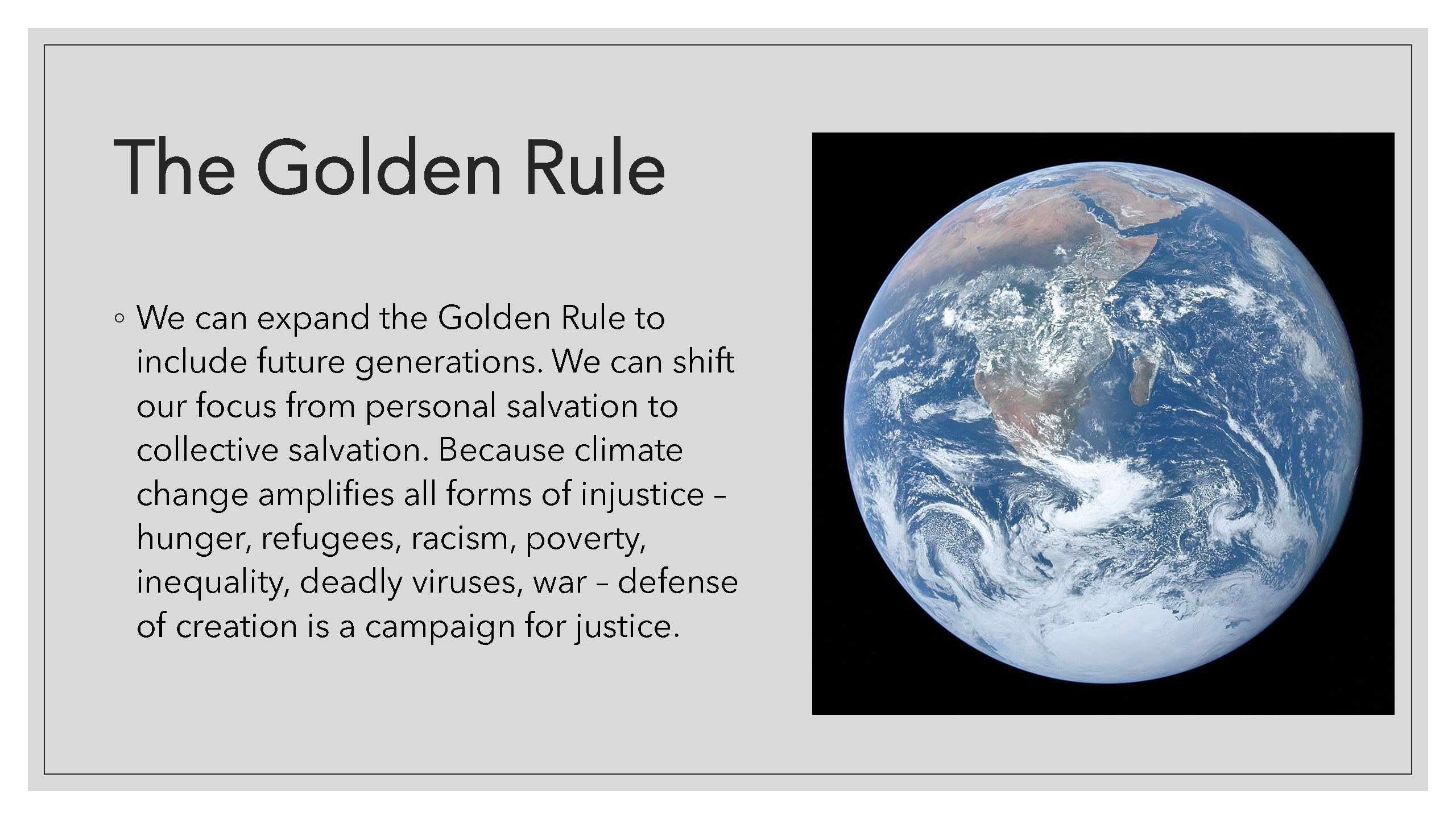
The problem with addressing climate change is that we are overly focused on the present rather than the future. This focus is particularly evident in business where the only target may be the results for the next quarter. Businesses also discount future earnings so that they remain focused on the present. This thinking leads to short-term results with little regard for the long-term effect of their actions. The church must work to change this mindset. One way to accomplish this is by explicitly changing the golden rule to include future generations: Do Unto Future Generations as You Would Have Them Do Unto You.
Climate Church advocates integrating climate change directly in the church service with at least one sermon a month addressing issues related to climate change. If we think about it, the church mentioning something as significant as climate change 12 times a year is not asking much. After all, climate change is irreversibly altering the planet and will have profound implications for the future.
One final thought is to compare our current use of fossil fuels with the use of other addictive substances. Do we find ourselves:
Taking fossil fuels in larger amounts or over longer period than intended?
Wanting to cut down or regulate use of fossil fuel, with multiple unsuccessful attempts to do so?
Spending a good deal of time obtaining and using fossil fuels?
Craving fossil fuels?
Using fossils fuels so much that it interferes with. . .work, home, or school?
Continuing to use fossil fuels even when it causes social or interpersonal problems?
Giving up or important . . .activities in order to use fossil fuels?
Continuing to use fossil fuels even when it is physically hazardous to do so?
Continuing to use fossil fuels despite already having a physical or psychological problem likely to have been caused by fossil fuels?
Requiring markedly increased amounts of fossil fuels as time goes on?
Developing withdrawal symptoms, such as agitation and irritability, when trying to quit?
We must conclude that we are addicted to fossil fuels and that we must take action now. I hope this discussion of Climate Church, Climate World has provoked additional thoughts on how the church might help address climate change. I am more than willing to do anything I can to help.
Note: This post is based on a presentation given at Central Lutheran Minneapolis Church on February 4, 2024.




 All About Images Blog